Disposals and septic tanks · Davie, FL
Can a Garbage Disposal Go on a Septic Tank in Davie?
Can a garbage disposal go on a septic tank in Davie? Yes: Florida's rule for sizing a septic tank counts bedrooms and floor area, and it has no line for a garbage disposal. The state's own owner guide still says to skip the disposal or use it less. If you keep one, the tank gets checked and pumped more often than the usual 3 to 5 years.
- A 3-bedroom home is sized at
- 300 gal/day
- · up to 2,250 sq ft, Rule 62-6.008
- Minimum tank for that flow
- 900 gallons
- · with a disposal or without one
- Licensed & insured: CGC1524886
- 500+ kitchens completed
- 2-year workmanship warranty
- Answered 7 AM–10 PM, 7 days
What Florida's Septic Rule Counts
A septic system in Florida is sized under Rule 62-6.008 of the Florida Administrative Code, and the rule starts from the house, not the kitchen. It sets a daily flow by bedrooms and building area. A home with 3 bedrooms and up to 2,250 square feet counts as 300 gallons a day. Each extra bedroom, or each extra 750 square feet, adds 60 gallons. When the bedrooms and the floor area point to different flows, the larger one wins.
That flow sets the tank. From 201 to 300 gallons a day, the minimum is a 900-gallon tank. The rule also requires an approved outlet filter, set in or after the last tank and before the drainfield.
Read the whole rule and the garbage disposal never comes up. There are no added gallons and no bigger tank for one. The companion rule on how tanks are built, 62-6.013, does not name it either, and it says a residence does not need a grease interceptor.
So the sizing rule does not decide this for you. The state's owner guide does take a side.
What the State's Owner Guide Says
The Florida Department of Environmental Protection runs the state's septic program and prints a short guide for owners. On disposals it is plain: the DEP's Septic System Owner's Guide says not to use a garbage disposal, or at least to limit it, and to have the tank checked more often if you do.
The reason is what the tank does. It separates and stores the solids, greases and oils that come down the drains, so only the liquid moves on to the drainfield. Whatever a disposal grinds goes into that same tank.
The guide also sets the baseline: have the tank inspected and pumped every 3 to 5 years by a state-licensed septage disposal service. It warns that excess solids, or a clogged or damaged filter, can make the system fail. That filter is the one the sizing rule requires.
Two of its habits apply at the kitchen sink with or without a disposal. Keep cooking oil and grease out of the drain, since they can clog the drainfield. And repair a leaking faucet promptly.
Deciding With the Sink Cabinet Open
In a remodel, the disposal question comes up when the sink comes out. The sink and its plumbing are disconnected and reconnected in the new cabinet, and that is when we install a new disposal, replace the old one or leave it out. What we need from you is the answer before the sink cabinet is drawn.
The EPA's page on caring for a septic system explains the trade. Food waste breaks down slowly in the tank and builds up as scum and sludge. If you must use a disposal, the EPA says, the tank will need pumping more often. Its advice is to cut the disposal out or limit it.
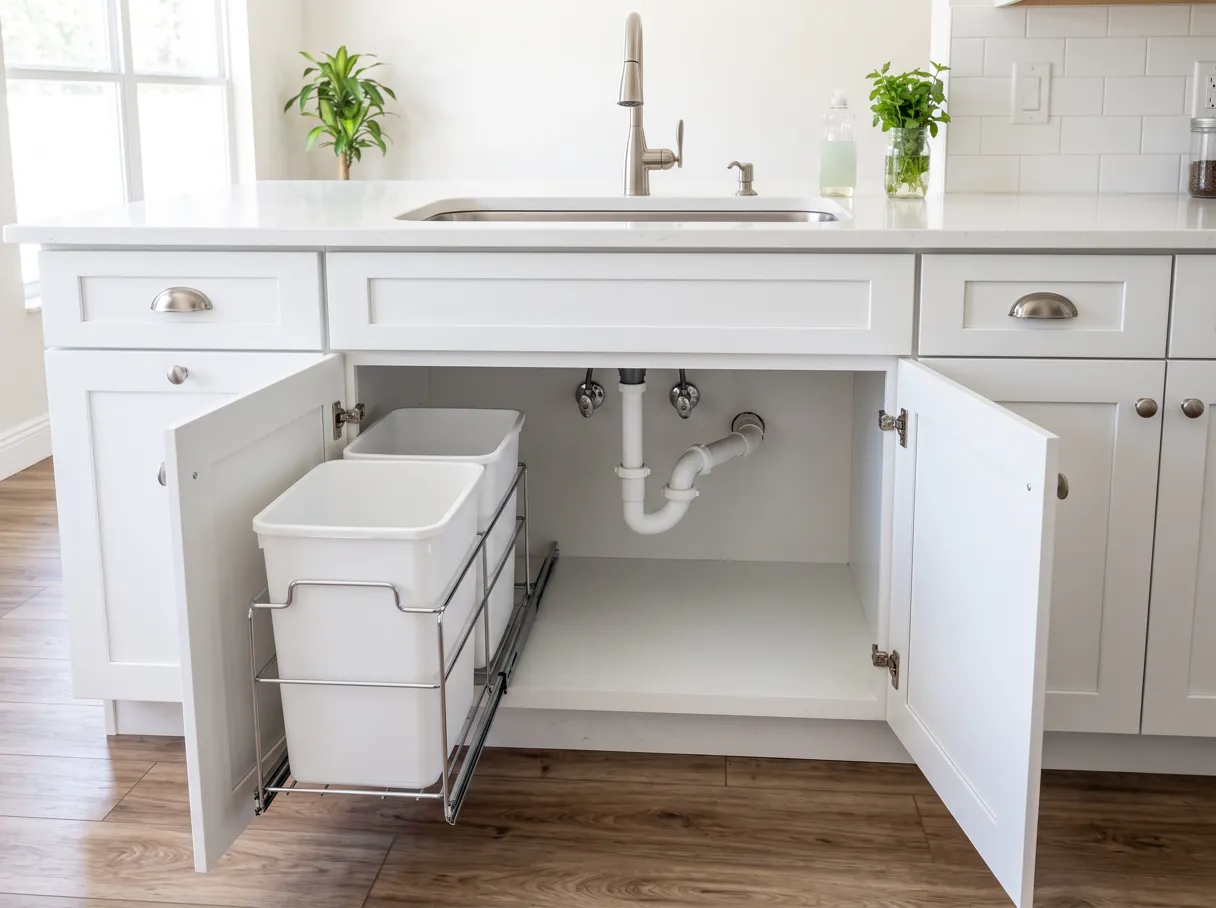
Leaving it out also frees the space under the sink. Without the unit, the base cabinet can hold a pull-out trash bin next to the drain, and the scraps go to the bin instead of the tank.
Either way, the new faucet can carry an aerator. The EPA counts faucet aerators among the ways to send less water into a septic system.